
What Is Rental Fire Insurance? A Complete Guide to Coverage, Costs, and Moving Procedures
When searching for a rental property or going through the lease process, "fire insurance" (kasai hoken) almost always appears on your initial cost estimate.
You might wonder, "I'm careful with fire, so why do I have to get it?" or "What situations does this insurance actually cover?"
In fact, rental fire insurance covers far more than just fire—it also helps protect you against water leaks, theft, and everyday accidental damage, making it an essential safety net for renters.
In this article, we explain how rental fire insurance works in a lease agreement, break down the three core types of coverage, share typical cost estimates by household size, and walk through important procedures for renewal and moving out (cancellation) !
Table of Contents
To put it simply, buying fire insurance is not a legal obligation under Japanese law. However, for nearly all rental properties in Japan, it is a mandatory condition of signing the lease agreement.
Even if you feel confident that you are careful around flames and heat, landlords and property management companies require it for two main reasons:
Under Japan's Fire Liability Act, if a fire accidentally starts in your unit and spreads to a neighboring building, you generally do not bear legal liability toward the neighbors unless there is gross negligence (such as falling asleep while smoking or leaving cooking oil unattended).
However, under your lease contract, you still have a restoration obligation—the duty to return the rented unit to its original condition when you move out. If your unit is burned or heavily damaged, repair costs can reach millions or even tens of millions of yen out of pocket. Fire insurance is designed to cover this risk.
Conversely, if a fire starts in a neighbor's unit and damages or destroys your furniture and appliances, the same Fire Liability Act generally means you cannot claim compensation from the neighbor. You need your own policy to protect your belongings.
In addition, fire insurance is frequently used for common rental incidents—such as a washing machine drain hose detaching and causing a water leak into the unit below.
Rental fire insurance policies typically bundle the following three core coverages as a set. Because the landlord insures the building structure itself (walls, pillars, etc.), tenants insure their own personal belongings and their liability risks.
① Household Goods Coverage — Protecting Your Own Belongings
Covers damage to your personal furniture, home appliances, clothing, and other items inside the unit caused by fire, lightning, rupture/explosion, wind/water damage, theft, and more. It helps pay to replace essential belongings you bought for your new home.
② Tenant's Liability Insurance — Preparing for Liability to the Landlord
Covers compensation owed to the landlord for restoration costs if you cause fire, explosion, water damage, or similar incidents that damage the rented unit itself (floors, walls, ceilings, or built-in fixtures). This is one of the most important coverages in a rental lease.
③ Personal Liability Insurance — Preparing for Liability to Others / Neighbors
Covers legal liability if an everyday accident causes bodily injury to someone else or damages someone else's property. In rental apartments, this often comes into play during water leaks affecting downstairs neighbors.
💡 It Can Actually Help in Situations Like These! Practical Use Cases
Rental fire insurance can also help with everyday issues beyond fire (depending on your plan terms):
[Household Goods Coverage ]
For example: A burglar breaks in and steals your TV, laptop, or cash (subject to policy limits).
For example: Strong typhoon winds shatter a window and blowing rain soaks your bed or sofa.
[Personal Liability Insurance ]
For example: Your washing machine drain hose comes loose and floods the ceiling and furniture of the apartment below.
For example: You accidentally collide with a pedestrian while riding a bicycle and cause an injury.
🔑Important Note: Earthquake Damage Is Not Covered
Standard fire insurance does not cover damage to fires or household goods caused by earthquakes, volcanic eruptions, or tsunamis. If you want protection against earthquake risk, you need to enroll in Earthquake Insurance together with your fire insurance.
Rental fire insurance arranged through a real estate agency is most commonly a 2-year contract.
Premiums vary depending on room size, household size (amount of belongings), and building construction (such as wooden vs. reinforced concrete).
・Single / 1 Person (1R–1K): Roughly ¥15,000 to ¥20,000 for a 2-year policy
・Couple / 2 People (1LDK–2LDK): Roughly ¥20,000 for a 2-year policy
・Family (2LDK and larger): Roughly ¥20,000 to ¥25,000 for a 2-year policy
Many renters aren't sure what their belongings are worth in total, but you do not need to itemize and add up every single possession.
Insurance companies typically suggest a guideline amount using a simplified valuation chart based on age and family size. If you own lots of designer items, high-end appliances, or expensive hobby gear (such as cameras or musical instruments), choosing slightly higher coverage than the baseline estimate can give you extra peace of mind.
Once a real estate agent presents a rental fire insurance plan, check these three points before signing any paperwork:
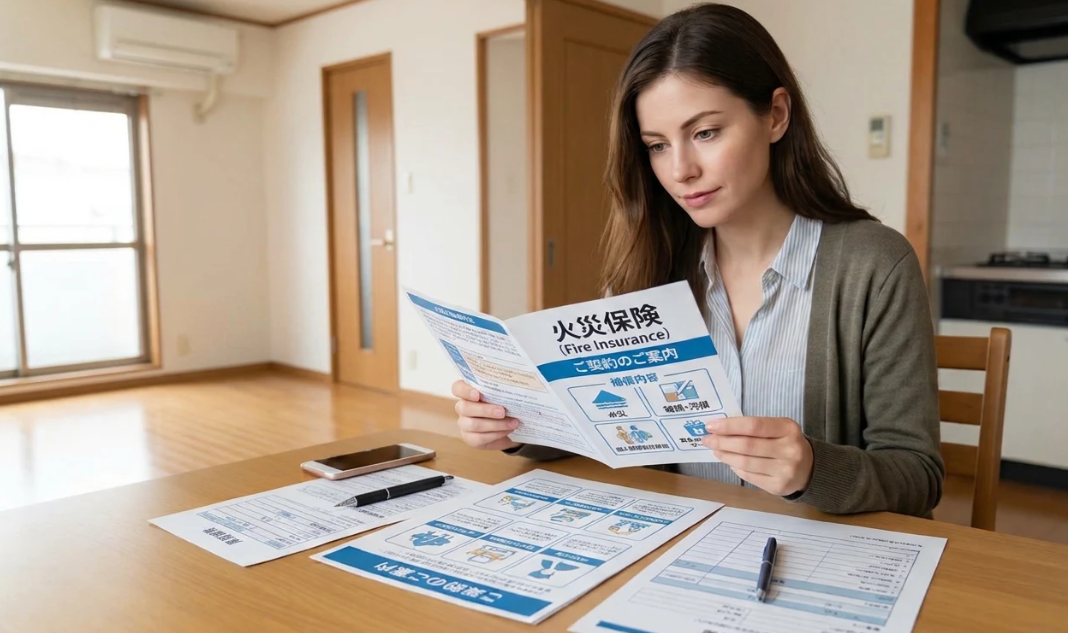
Water damage coverage protects against floor-level flooding or landslides caused by typhoons or heavy rain. If you are renting on the ground floor or a semi-basement level, living near a river, or staying in an area flagged on a hazard map for flood risk, make sure water damage coverage is included. It is also worth checking whether accidental breakage/soiling coverage is included for everyday slips or moving-day mishaps involving your furniture or appliances.
If you already have personal liability coverage through car insurance, bicycle insurance, or a credit card benefit, your coverage may overlap.
Because rental fire insurance plans are often packaged and cannot always be modified item by item, checking your—or your family's—existing insurance certificates is still a smart step.
Rental fire insurance policies frequently include a 24/7/365 emergency dispatch service at no extra charge.
These services can arrange help or basic emergency fixes—free or at a preferential rate—for everyday headaches like locking yourself out or dealing with a clogged toilet. Keep your policy certificate and brochure handy after signing up so you have the contact details when needed.
Buying fire insurance isn't the end of the process—you also need to take action when renewing your stay or moving out.
🏠 When Renewing Your Lease (Typically Every 2 Years)
Your fire insurance policy usually reaches expiration around the same time as your lease renewal (often every two years).
A renewal notice will typically arrive from the insurer or property management company 1 to 2 months before expiration, so be sure to complete the renewal procedure and payment before the deadline.
Accidentally letting your policy lapse into an uninsured period can violate your lease terms and leave you without coverage if an incident occurs.
🚚 When Moving / Canceling Mid-Term
If you move to another property before the policy term ends, you must contact the insurance company yourself to cancel the policy.
・You may receive a refund : If you paid the full 2-year premium upfront, you can generally receive a refund proportional to the remaining coverage period.
・It does not cancel automatically: Canceling your rental lease does not automatically cancel your fire insurance. Once your move-out date is set, contact the insurer by phone or online using the details on your policy certificate.
Rental fire insurance is more than just another line item in your initial move-in costs—it helps protect your daily life from both damage to your own belongings and high liability risks toward your landlord and neighbors.
♦ A reliable safeguard beyond fire alone: Helps cover everyday risks such as water leaks, theft, typhoons, and bicycle accidents.
♦ Typical cost is roughly ¥15,000–¥25,000 for 2 years: Coverage is set around your household size and belongings so it stays practical.
♦ Don't forget post-contract steps (renewal & cancellation): Renew on time if staying put, and cancel yourself when moving out to claim any applicable refund.
When going through your lease paperwork, ask your real estate agent to walk you through the coverage details and emergency dispatch services so all your questions are answered before you sign. With a clear understanding of how it works,
you can start your new life in Japan with greater confidence and peace of mind!